
My Dad's Last Lesson
Don't let money, or anything else, get in the way of your relationship with God

A Hard Year
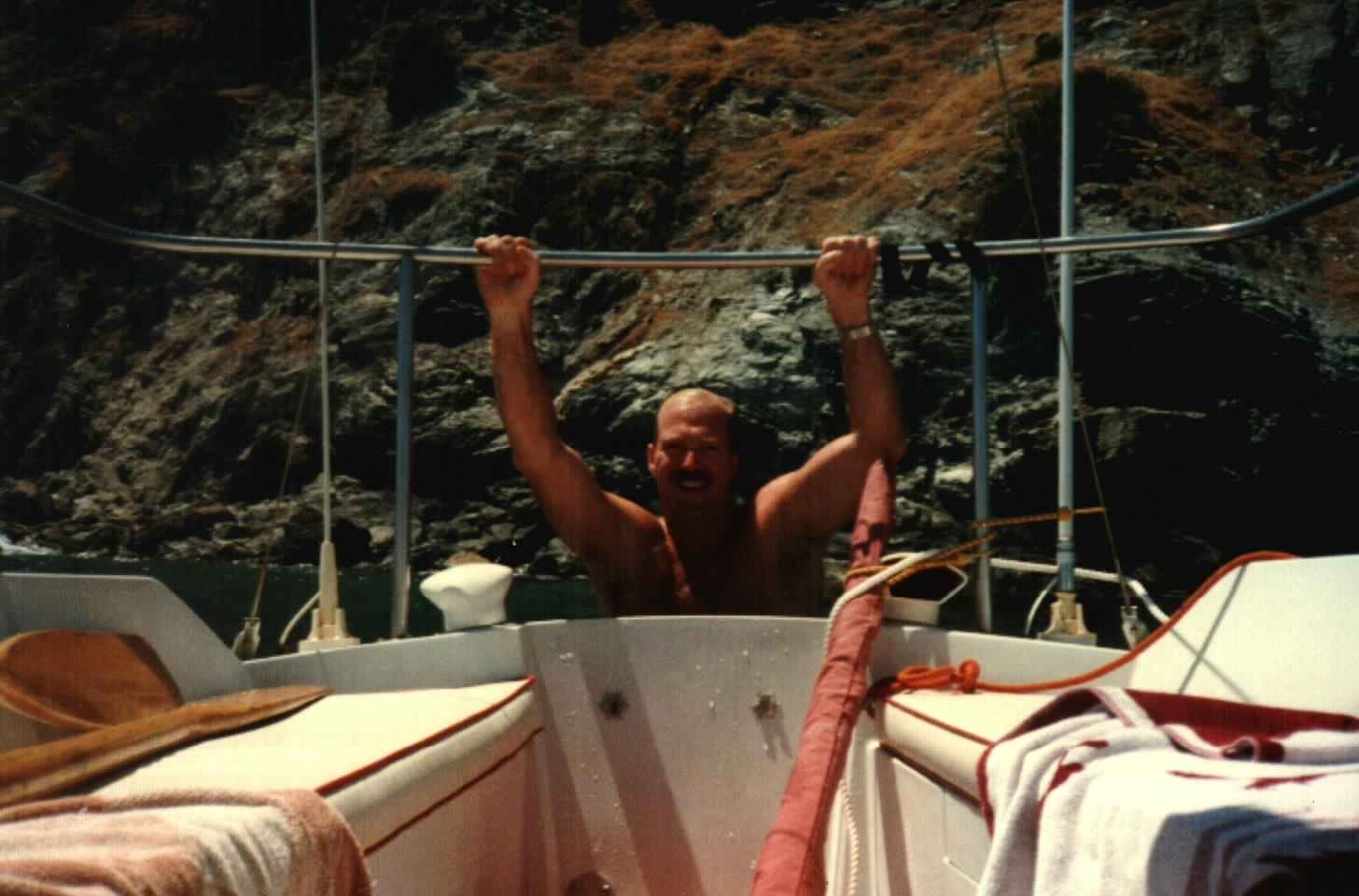
My dad, Tom Oyan, hanging off of his sailboat in the waters of Catalina island
It’s been just over one year since I lost my dad. The genesis of this newsletter was in large part because my dad was elected the elder of stewardship at his church in Scottsdale, Arizona. Unfortunately, he became too sick to ever carry out his role. For that reason, I decided to write about Christian stewardship, largely focusing on finances and giving, with the understanding that we can define stewardship as, “Everything we have belongs to God.”
I have been grateful for my dad, even in death, for the enduring lessons that he taught my brother and me.
On the Sunday before the first anniversary of his death, my dad’s pastor, Erik Khoobyarian, of Pinnacle Presbyterian Church in Scottsdale, Arizona, preached a wonderful sermon that greatly honored my father. This post highlights one of the last great lessons my dad taught, and I can joyously say that he is still teaching.
A link to the sermon is here.
Desiring God
When my dad became the elder of stewardship, Pastor Khoobyarian thought he would have strategies for fundraising, spending money wisely and efficiently, and bolstering the church’s coffers for its missional pursuits.
In early conversations with my dad, Khoobyarian recalled:
We dreamed together—I shared with him my dream for this church that we would be in a position in a few years where our stewardship campaign would result in pledges and giving where we would be left with surpluses beyond our budget, so that we could bless the community around us and our mission partners even more. I shared with him my dream that we would grow our foundations so that we could build a lasting legacy at Pinnacle for generations to come—Tom loved my dreams; he was quick and ready to lead our stewardship efforts, and I was ready for us to talk nuts and bolts of church fundraising. He was so excited coming in that I thought he was going to have all of these great ideas of ways that are going to be the magic trick, the magic bullet to raising money.
However, shortly thereafter, my dad became critically ill and entered hospice. Once treatments had ceased, Pastor Khoobyarian was surprised that my dad was still hoping to have conversations about stewardship. He articulated:
Tom still wanted to talk about stewardship. I’ll admit, I wanted to talk about money. I wanted to talk about the ways that we were going to solve all of the problems and the challenges, but we never talked about money. He wanted to talk to me about a message that was on his heart—a message that I believe was deeply in his heart.
Here we are at the crux of the matter. In what rational world would pastors, elders, and other church officials NOT think about money when discussing church initiatives, fundraisers, or giving campaigns? On the surface, it doesn’t make sense. What pastor Khoobyarian would discover, and what in death my dad taught, is as follows:
This was his message when he came to see me about stewardship. I was expecting a strategy. I was expecting a can’t-lose approach to shattering goals and easing all of my woes. I was expecting answers to the financial pressures that all churches feel. But you see the message that he shared with me and the same message that he would share with me over and over again whenever we were together was a message of the inescapable God who desires us, who loves us, who seeks us, who designed us in the divine image, more than anything else to be seekers and followers of Jesus—and we would talk about a world that seems to try and separate us from God. The pain of our lives, the struggles that we have, but also our successes—he talked a lot about that. Success and having resources and wealth can sometimes be what keeps us from experiencing God’s love—He talked about other ways that we put things in the way of God, and then how his desire was always that people would see that there was a way that they could experience God’s love more deeply, and I finally figured it out—it’s not having money that’s the issue, it’s the way that our desires in life, whether it’s our desire for wealth or our desire for success, or our desire for money, any of these desires that we put in the way of our desire for God. So it is that the giving, the generosity, is a way that we surrender this before God. Ultimately, the reason we do it is not to feel good and feel warm. The reason we do it is because it enables us, it frees us, to encounter this God who loves us so deeply. So his desire to encourage others to give and to be stewards and to be generous, sure, it was a desire to help the ministry of this church, but really it was a desire like Paul’s desire in writing to Timothy—it was a desire that others would come to know and understand the loving God who they experienced in their lives. It’s a subversive tool, but a beautiful one, because we are all searching for this God.
The message my dad had on his heart, masterfully communicated and polished by Pastor Khoobyarian, is that people let things get in the way of an authentic encounter and subsequent relationship with the living God. An example of this is money, which, in relation to Christian stewardship, is secondary to desiring God. Counting pennies is less important than the spirit of generosity of the giver. The very act of being generous brings us closer to God and removes a powerful roadblock in our ability to holistically pursue Him with our lives.
You may read this and still have some questions about the nuances of this message. What if a wealthy Christian gives millions of dollars to a church or a wonderful Christian cause? Sure, it would be a blessing if every church could raise millions of dollars and put the money toward worthy, meaningful, gospel-centered causes. Yet, focusing on the amount of money is a part of the problem that people run into. If anything, the amount of money given should probably be a private matter unless, for the sake of teaching, it is appropriate to disclose such information. Our practice of giving is an act of obedience, whereas the dollars themselves won’t accompany us in the resurrection.
If we highlight our definition of stewardship once more — “Everything we have belongs to God” — then anything we have isn’t ours to begin with. We have been entrusted by God to use our resources in the best ways for Him!
No King but Christ
Sometimes I have to stop and think about the fact that we worship a king. It might seem ridiculous, but imagine that you are a member of a medieval royal court. The king walks into the grand hall and everyone respectfully bows, knowing that this king has the power of law, of life, and of death. If this king had lent you money to invest in righteous causes, what would you do? Squander his money at your own peril.
If a king entrusts you with his resources, the expectation is faithfulness. How much more does this apply when the King is Christ?
Zooming back out to the present, this doesn’t mean that we shouldn’t lovingly care for our families and prepare for retirement or periods of financial strife, but it does mean that if we find ourselves too enamored by numbers, it can hijack a rich faith with a shallow concern for worldly things that will pass away.
Pastor Khoobyarian mentioned in his sermon the famous CS Lewis’ quote from his book Mere Christianity:
Every Christian is to become a little Christ. The whole purpose of becoming a Christian is simply nothing else.
We aren’t guaranteed tomorrow. If, as Christians, we are in the business of saving souls, what good is hoarding money when the opportunity cost is eternal?
The photograph at the beginning of this post is of my dad sometime in the 1980s on his sailboat, Escape. In the photo, he’s clearly soaking wet, having just jumped into the waters off of Catalina Island, 20 miles west of Los Angeles. According to my dad’s friends, he would jump into the water each morning because it was like a baptism. He could start his day by giving it to God in a symbolic act of renewal and devotion. I pray that God would be on the forefront of our minds each day, and in whatever our habits and rhythms for connecting with Him, like jumping into the deep blue of the Pacific, we would do so with so much confidence, hope, love, and joy, that it is like we didn’t have a choice in the first place.
My dad’s life reminds me that stewardship isn’t about money, it’s about desire. It’s about wanting God more than anything we hold onto.
Questions for Reflection
What stumbling blocks get in the way of your relationship with God?
Do you find yourself wishing you were wealthy?
Have you set up recurring payments to your church or Christian charity?
Is generous giving one of your top financial priorities?
Greg, you got it! Your Dad is celebrating you!!
Boy do I miss him!!