
Why Don't We Change?
What Tiger Woods and modern neuroscience teach us about modifying our behavior and stewarding our actions

The Trade Off
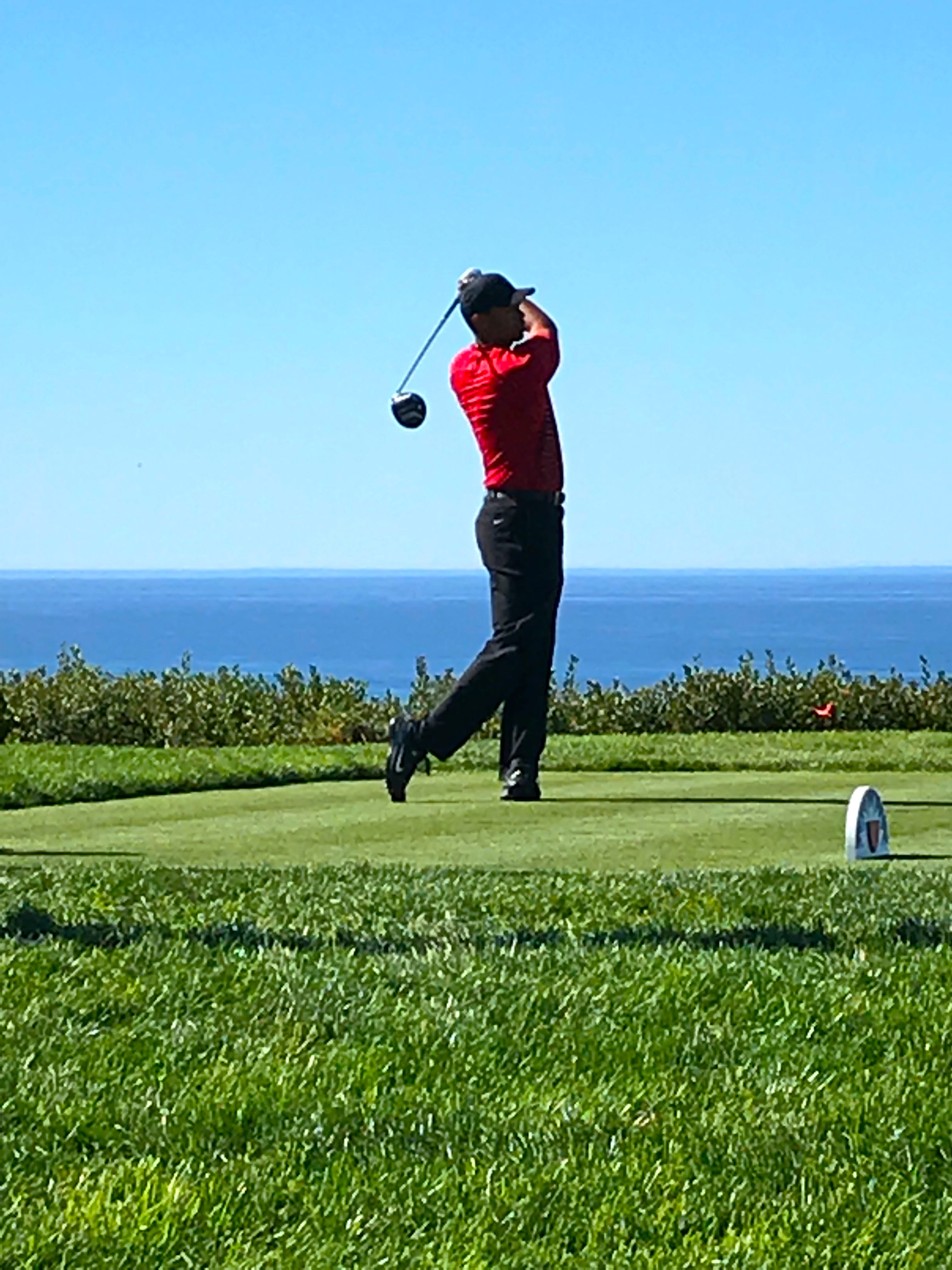
Source - I took this photo at the Farmers’ Insurance Open on the 4th hole of the South Course at Torrey Pines in La Jolla, CA
Who’s the most famous person you’ve ever seen firsthand? Have you ever felt captivated by the presence of a celebrity? I’ve been to a variety of concerts and sporting events, as I suspect many of you have too. Now and then, I’ve seen a celebrity in a restaurant or at the airport. However, I can say without a doubt that I have never been around anyone as captivating as Tiger Woods.
I’ve seen Tiger in a few different golf events. He’s never won anything I’ve watched, but he’d always garner the biggest crowds. A few minutes before I took the above photo, I stood within 3 feet of him as he walked by. He had a mesmerizing focus and a confidence that I can truly say is indescribable. It’s what some people might call a ‘vibe’ or an ‘aura’.
Tiger’s achievements are too many to list, but he is tied as the all-time leader in PGA Tour wins with 82 and has 15 major championships. Between 2000 and 2001, Tiger won 14 events, including all 4 majors. This feat was so incredible that it was called the “Tiger Slam.”
With golf success came fame and fortune. In 2009, the LA Times reported that Tiger Woods was the first billion-dollar athlete, beating out the likes of Michael Jordan and Michael Schumacher.
In 2009, Tiger was married to supermodel Elin Nordegren and subsequently had two kids. He had just won the 2008 US Open at Torrey Pines, and the world eagerly anticipated how long it might take him to win 5 more majors and pass up Jack Nicklaus as the undisputed GOAT of golf. What transpired next was one of the great falls from grace of modern times. Tiger admitted to infidelity, and after months of continuous scandal, he divorced his wife and took a break from professional golf.
Following rehab, Tiger articulated:
“I thought I could get away with whatever I wanted to", he said. "I felt that I had worked hard my entire life and deserved to enjoy all the temptations around me. I felt I was entitled. Thanks to money and fame, I didn't have to go far to find them. I was wrong. I was foolish.”
What a tragic and familiar story. The economic fallout of the scandal was reportedly upwards of $12 billion.
To this day, I am a big Tiger fan. I don’t think he’ll ever win another major, or even another golf tournament, but it’s hard not to root for him. I think it’s a good example that we are all capable of redemption.
Don’t get me wrong, what Tiger did was reprehensible, and the whole world knows that. He did not steward his power, influence, or body well. The reality is, though, neither do you and I. At least, not in every situation. We have great biblical examples of this, like Moses and King David. Both of these biblical heroes were guilty of appalling transgressions, and yet God still used them for His great works. As holistic stewards of our lives, we are responsible for our words and actions. We are told to deny our temptations and seek after God in all things. We all fall short of accomplishing this. Yet, what are some strategies we can use to improve our odds?
Avoiding Bad Situations
When people get sick, they often head to the pharmacy to pick up medicine to alleviate their symptoms. If someone never washes their hands and frequently gets sick, any sane person would implore them to start washing their hands more frequently to prevent illness. Why focus on symptom management instead of avoiding sickness in the first place? In the same manner, if we are prone to alcoholism, drug use, sexual immorality, gambling, compulsive spending, or the various other common temptations, the best way to fight these vices is to avoid them entirely. I am reminded by Jesus’ words in Matthew 5:30:
"And if your right hand causes you to stumble, cut it off and throw it away. It is better for you to lose one part of your body than for your whole body to go into hell."
At first, this might not seem like practical advice. We all understand that Jesus’ words are metaphorical and that he means that we should rid ourselves of anything and everything that might separate us from Him or His will. What is less clear is exactly how to do that.
As many of us have experienced in our lives, it’s hard to stop ourselves from doing something we ought not to do.
For instance, take a blackjack table. You have $100 in your pocket at a $10 dollar-per-hand table. You start to lose money and try to recoup your losses. Eventually, you end up with nothing when you could’ve stopped when you had $80 and only lost $20.

Andrew Huberman, a Stanford neuroscience professor and one of the world’s most popular science and technology podcasters, explained the complexities of the human reward system while on the Rich Roll podcast:
“Our reward systems are not designed for things that are just good for us—they’re designed for things that optimize the progression of our species—they will grab onto and ratchet into any behavior that makes us feel good. The human brain isn’t optimized to make best choices.”
“If you change your behavior, then generally your thoughts, your feelings and your perceptions change. Everyone tries to come at it from the other end—I don't want to relegate feelings. Feelings are extremely important. I don't want to relegate perception. They're extremely important. But when it comes to wanting to shift the way that you function to get better or to perform better and to show up better or to move away from things like addictive behaviors, it's absolutely foolish for any of us, me included, to think that we can do that by changing our thoughts. First, it's behavior—thoughts, feelings and perceptions follow.”
The golden rule of modern neuroscience can be summed up by: mood follows action. This is counterintuitive. Take for example, smiling. Smiling is a behavior that you’d think is caused by feeling happy. However, as popularized by author Malcolm Gladwell in his book Blink, smiling, even when forced to hold a pen between your teeth, actually makes people feel happier and rate things as more enjoyable. The facial muscles send feedback to the brain about how you should be feeling.
As Christians, I think many of us turn to prayer and Bible reading in an effort to feel different. We pray things like, “God, please help me escape my drinking problem, or my gambling addiction, etc.” This can be a helpful practice, and the mechanism is similar to what neuroscience tells us about behavior and mood. These kinds of spiritual disciplines are effective, but not because all of the sudden we won’t enjoy gambling or drinking. Instead, what has really changed is the use of our time. The more time we spend reading God’s word and praying, the less time we spend ruminating or carrying out our sins. Just as smiling can make us feel happier, prayer and Scripture reading can reshape our thoughts and feelings through the behavioral change itself.
Our Hope
Despite great effort and aggressive behavioral changes, we will still fall short of perfection. Like Tiger Woods, we can justify our sin and, with good intentions, pray to think and feel differently. Unless God, in his sovereignty, chooses to change our hearts miraculously, real change won’t come from strength of will alone. Instead, we have to, through faith, change the way we live and act. If we are obedient to God, we will feel the amazing joy offered to us by a life devoted to Jesus.
As Paul articulates in Ephesians 2:1-10, we are dead to our sins and alive in Christ:
“As for you, you were dead in your transgressions and sins, in which you used to live when you followed the ways of this world and of the ruler of the kingdom of the air, the spirit who is now at work in those who are disobedient. All of us also lived among them at one time, gratifying the cravings of our flesh and following its desires and thoughts. Like the rest, we were by nature deserving of wrath. But because of his great love for us, God, who is rich in mercy, made us alive with Christ even when we were dead in transgressions—it is by grace you have been saved. And God raised us up with Christ and seated us with him in the heavenly realms in Christ Jesus, in order that in the coming ages he might show the incomparable riches of his grace, expressed in his kindness to us in Christ Jesus. For it is by grace you have been saved, through faith—and this is not from yourselves, it is the gift of God—not by works, so that no one can boast. For we are God's handiwork, created in Christ Jesus to do good works, which God prepared in advance for us to do.”
Notice how Paul says that we used to follow the ways of the world. Following is an action. It means that we have acted in ways that won’t allow us to experience the “Incomparable riches of his grace.”
Even Tiger Woods, though seemingly not a Christian, recognized the ills of his ways, saying, “I was wrong. I was foolish.” Think of how common it is to know that what we are doing is wrong and then to go ahead and do it anyway.
The antidote to falling into sinful thought or feeling is to behave differently. If we keep a habit of prayer and Bible reading, it opens up an avenue to think about situations in a manner that allows us to act in the ideal way. A byproduct of this righteous action is joy. Instead of pessimism, despair, and the doom of constant struggle with temptation, we can experience the gifts of God.
In short, He has created us with embodied systems that reward exactly what He has written down in Scripture as the right ways of living. We’ve been given an instruction manual on how to best steward ourselves and our actions. We ought to follow it!
Questions for Reflection
In your life, think about how you fall short. Think about what behaviors you might want to change or what you might want your future self to look and act like.
Ask yourself some of the following questions:
What behaviors in my life am I most prone to justify or rationalize?
What does my daily routine reveal about my true priorities and values?
What situations, places, or relationships consistently lead me toward temptation?
In what areas of my life am I waiting to “feel like it” before I act obediently?
Note: Over the summer, this publication will be released on a weekly or biweekly basis as opposed to a weekly basis.